
Why Digital Donor Walls Are Growing in Healthcare and Higher Education
Ten years ago, a hospital foundation or a university advancement office ordered a donor wall once, at the end of a campaign, and lived with it for a decade. Today the same teams ask a different question: how do we recognize a donor list that changes every quarter, in a building that may get renovated before the campaign closes?
That question explains most of the shift. Digital donor recognition walls are growing in healthcare and higher education because both sectors now run continuous, purpose-specific fundraising rather than one campaign per decade. At Donor Signs, we see this pattern in nearly every discovery call with a hospital foundation or a university development team.
This article explores the specific pressures driving that growth in these two sectors. It ignores format comparisons and how-to guides, focusing instead on why the demand curve moved, using the sector's own reported numbers.
Both Sectors Are Raising More Money, From Fewer People
Digital donor recognition growth starts with fundraising data, not technology.
Giving to health reached $61.43 billion in 2025, up 6.1% in current dollars, and giving to education grew more than 10%, making it one of the fastest-growing categories in the entire nonprofit sector Giving USA 2026, Indiana University Lilly Family School of Philanthropy. More dollars mean more donors who expect recognition, alongside more giving levels to represent.
The second half of the story matters more for recognition design. In higher education, CASE estimates total voluntary support at $78.8 billion, while the number of alumni donors fell for a fourth consecutive year and median alumni giving per donor rose to $1,895 CASE Insights on Voluntary Support of Education, 2025 Key Findings. Fewer donors give larger individual sums.
That combination changes what a recognition display must accomplish. A narrower donor base with larger individual gifts needs deeper recognition per person—a story, a photo, a named space, a reason —rather than simply another engraved line in a longer list. Static panels list names well, but they tell stories poorly.
Recognition Now Follows Restricted, Purpose-Specific Gifts
The same CASE findings report that 81% of donations to higher education carried a designated purpose. Donors increasingly fund a specific program, scholarship, lab, or unit rather than a general fund.
Purpose-specific giving fragments the recognition problem. A university that once needed one campaign wall now needs recognition for a scholarship cohort, a research center, an athletics facility, and an annual fund, each with its own donor list and update cycle. A hospital foundation faces the same fragmentation across a cancer center, a NICU, an emergency expansion, and a community health program.
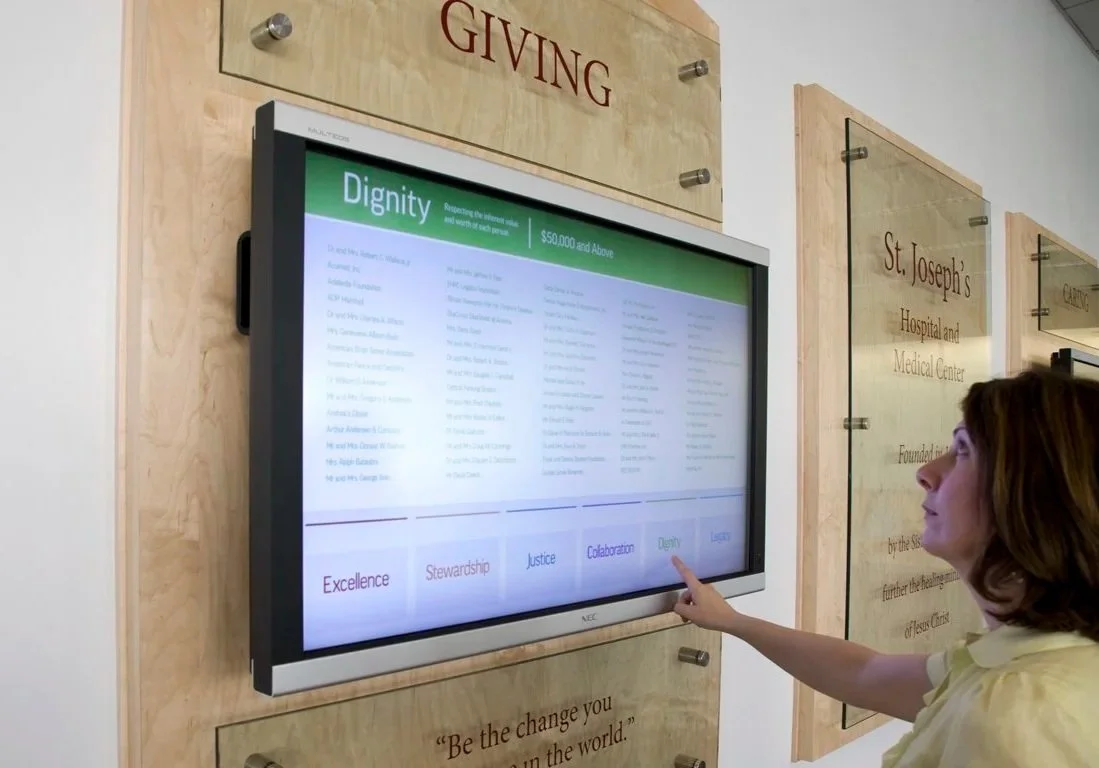
Digital displays absorb that fragmentation because one screen holds many recognition programs, each with its own view. A visitor taps the cancer center and sees that donor list; a dean opens the scholarship view during a stewardship visit. The wall stops acting as a single monument and becomes a container for several recognition programs, seamlessly showing how digital donor recognition fits a broader stewardship strategy.
Hospitals Are Building at Record Levels, and Buildings Outdate Walls
Healthcare adds a second driver that higher education feels less sharply: construction churn.
Hospital and health system capital expenditure in fiscal 2025 reached its highest level since 2008 as a share of depreciation expense, driven by aging facilities, capacity shortages, and ambulatory expansion, according to Fitch Ratings data reported by the Healthcare Financial Management Association. Industry trackers put the hospital construction pipeline at roughly 79 million square feet, worth an estimated $93 billion.
Every renovation puts a fixed donor wall at risk. A permanent bronze installation in a lobby that gets reconfigured in year six becomes a problem with no good answer: relocate it, rebuild it, or leave it in a corridor that no longer carries traffic. Development teams watch this happen and prioritize flexibility during planning.
A digital display changes the exposure. The hardware relocates, and the recognition content moves with it, untouched. The foundation protects years of recognition decisions without renegotiating them with donor families, making digital donor wall solutions for hospitals and healthcare an essential investment.
Higher education carries a quieter version of the same risk. Campus buildings get repurposed, departments merge, and a wall installed for one school ends up in a space that another school now occupies. Recognition content living in software survives those moves without a single fabrication order.
Update Frequency Became the Deciding Factor
Ask a development director what their old wall cost them, and the answer rarely points to the purchase price. It points to the update.
Consider a community hospital foundation with a giving society of 400 members, refreshed annually. On engraved plaques, each annual refresh demands new plaque production, a fabrication lead time, an installer visit, and a coordination burden on a two-person development office. Multiply that by ten years, and the update work outweighs the original build in both cost and staff hours.
The same foundation on a digital display updates the list from a spreadsheet or a CRM export before the donor event, completing the task in an afternoon. Nothing gets fabricated. Nothing gets shipped. That single operational difference persuades more teams than any design argument.
Staffing drives this decision as well. Development offices in both sectors run lean, and a director of stewardship spending three weeks a year coordinating plaque production loses valuable time with donors. Teams increasingly measure a recognition system by how little of their calendar it consumes.
Universities feel the same pressure on a different cycle. Annual fund leadership circles, reunion class gifts, and athletics giving all refresh yearly, and each refresh competes for the same staff time as the campaign itself. Exploring how universities use donor walls to inspire major gifts helps teams navigate these cycles effectively.
Digital Displays Create Recognition Capacity Where Wall Space Ran Out
Physical space imposes a hard ceiling. A lobby wall holds a set number of names at a legible size. Once a campaign exceeds that threshold, the team faces an unhappy choice: shrink the type, cut lower giving levels, or expand into space the architect never allocated.
An academic medical center running a $250 million campaign with 3,000 recognized donors cannot list 3,000 names legibly in a lobby. It can, however, display the top giving levels permanently and hold the full donor list in a digital directory beside them. Nobody drops off the list, and the architecture stays intact.
This reality drives the growth of hybrid installations alongside purely digital ones. The permanent element carries prestige and gravity; the digital element carries depth and volume. Teams no longer have to choose; they can compare honoring major donors with including everyone by comparing physical, digital, and hybrid donor walls.
Both Sectors Now Expect Recognition to Prove Its Value
Hospital foundations and university advancement offices report to boards that demand tangible returns. A static wall offers no evidence beyond its mere existence.
Digital systems produce observable engagement metrics: which stories visitors open, how long they stay, and which sections draw attention during events. That data gives a development director concrete metrics to bring to a board meeting while guiding the next round of content updates.
More importantly, the content itself becomes a fundraising tool. A development officer walking a prospect through a display can pull up the named-space program, show how previous donors appear, and make the recognition offer tangible in the moment. Print collateral cannot achieve that on the spot, highlighting the power of well-planned naming opportunities and named space programs.
A Short Illustration From Each Sector
A regional health system completed a patient tower and planned a traditional recognition wall for the main entrance. Midway through design, the facilities team confirmed that the entrance sequence would change again within five years as a second phase opened. The foundation shifted to a digital display with a permanent architectural surround, kept the surround in the design package, and now moves the screen alongside the entrance. Its recognition content has survived two facility changes.
A private university faced the opposite constraint. Its historic library lobby could not accept a large new installation without a heritage review, and the campaign had 1,400 donors to recognize. The advancement team installed a compact digital directory beside a modest engraved panel naming the lead gifts. The heritage character stayed intact, and every donor appeared.
Neither team chose digital for novelty. Each chose it because a fixed constraint- construction churn in one case, protected architecture in the other- made a fixed wall the wrong instrument, proving what makes a donor wall successful in institutional spaces.
What This Means for Your Next Recognition Decision
Growth in digital donor walls does not mean physical recognition fades away. Bronze, glass, and dimensional lettering still carry a permanence that screens cannot imitate, and donors feel that difference deeply.
The decision now turns on three practical questions. How often will this donor list change? How likely is this space to change? And how much staff time can your team spend on updates each year? Sectors with volatile answers to those questions healthcare and higher education, above all continue landing on digital or hybrid systems.
Sector context helps as well. A hospital foundation entering a multi-phase build and a university protecting a heritage lobby reach the same digital answer for entirely different reasons, and each requires a different balance of permanent and digital elements. The right system reflects the constraint, not the trend.
Answering those three questions honestly before choosing a format clarifies the final decision, especially when evaluating what a donor recognition wall costs.
Frequently Asked Questions
1. Why are hospitals switching to digital donor recognition?
Hospitals often renovate and expand, so fixed walls risk becoming obsolete as spaces change. Digital displays relocate with the recognition content intact and let small development teams update donor lists without ordering new fabrication.
2. Are digital donor walls better than traditional donor walls?
Neither format excels in every case. Digital walls suit changing donor lists, high recognition volumes, and spaces likely to be renovated, while permanent materials suit stable lists and prestige recognition for lead gifts.
3. How much does a digital donor wall cost?
Cost depends on screen size and quantity, the architectural surround, software, content development, and installation conditions. Ongoing expenses include software, content updates, and hardware maintenance, requiring teams to compare total cost over ten years rather than purchase price alone.
4. How often do you need to update a digital donor wall?
Most organizations update at least annually, timed to the giving-society renewal or a donor event. Institutions with rolling campaigns often update quarterly, which digital systems handle without fabrication lead times.
5. Can a donor wall be both physical and digital?
Yes. Hybrid installations pair a permanent engraved or dimensional element for lead gifts with a digital directory that holds the full donor list, preserving prestige while removing the space ceiling.