
How Much Does a Donor Recognition Wall Cost?
A donor recognition wall can cost anywhere from approximately $2,500 to more than $250,000, depending on the scale and complexity of the recognition system. We understand that for a nonprofit, healthcare facility, or university, every dollar spent must be directly tied to your mission. A donor wall isn't just a line-item expense; it is a strategic investment in future stewardship, a powerful storytelling tool, and a physical testament to the generosity that fuels your cause.
Whether you need a simple plaque program or a campus-wide custom installation, the final budget hinges on your donor hierarchy, material choices, technology integration, and future update flexibility. The ranges below serve as planning estimates to help your board or committee confidently navigate the financial planning of your next Donor recognition budget.
Hello, World!
Note: These ranges work as planning estimates. Every project has unique site conditions, donor list requirements, and architectural considerations.
Donor Recognition Wall Cost by Project Type
The most significant factor in your overall budget is the type of installation required for your space. Different campaigns and facilities demand different approaches.
Simple Donor Plaque Display (~$2,500 – $10,000)
This entry-level option is ideal for smaller, focused campaigns, memorial gifts, room naming rights, or organizations dealing with limited architectural wall space. Because it typically uses engraved plaques, printed nameplates, or simple acrylic panels with basic mounting hardware, the design and fabrication complexity remains low. It is highly cost-effective but best suited for permanent, stable donor lists that do not require frequent updates.
Modular Donor Recognition Wall (~$10,000 – $35,000)
Modular walls are designed with the future in mind. This system utilizes replaceable panels, interchangeable magnetic tiles, or standardized plaques, making it the perfect solution for growing donor lists, annual funds, or phased capital campaigns. By planning the future update frequency during the initial design phase, a modular system helps you avoid the hidden costs of rebuilding an entire display when new gifts are secured.
Custom Dimensional Donor Wall (~$25,000 – $75,000)
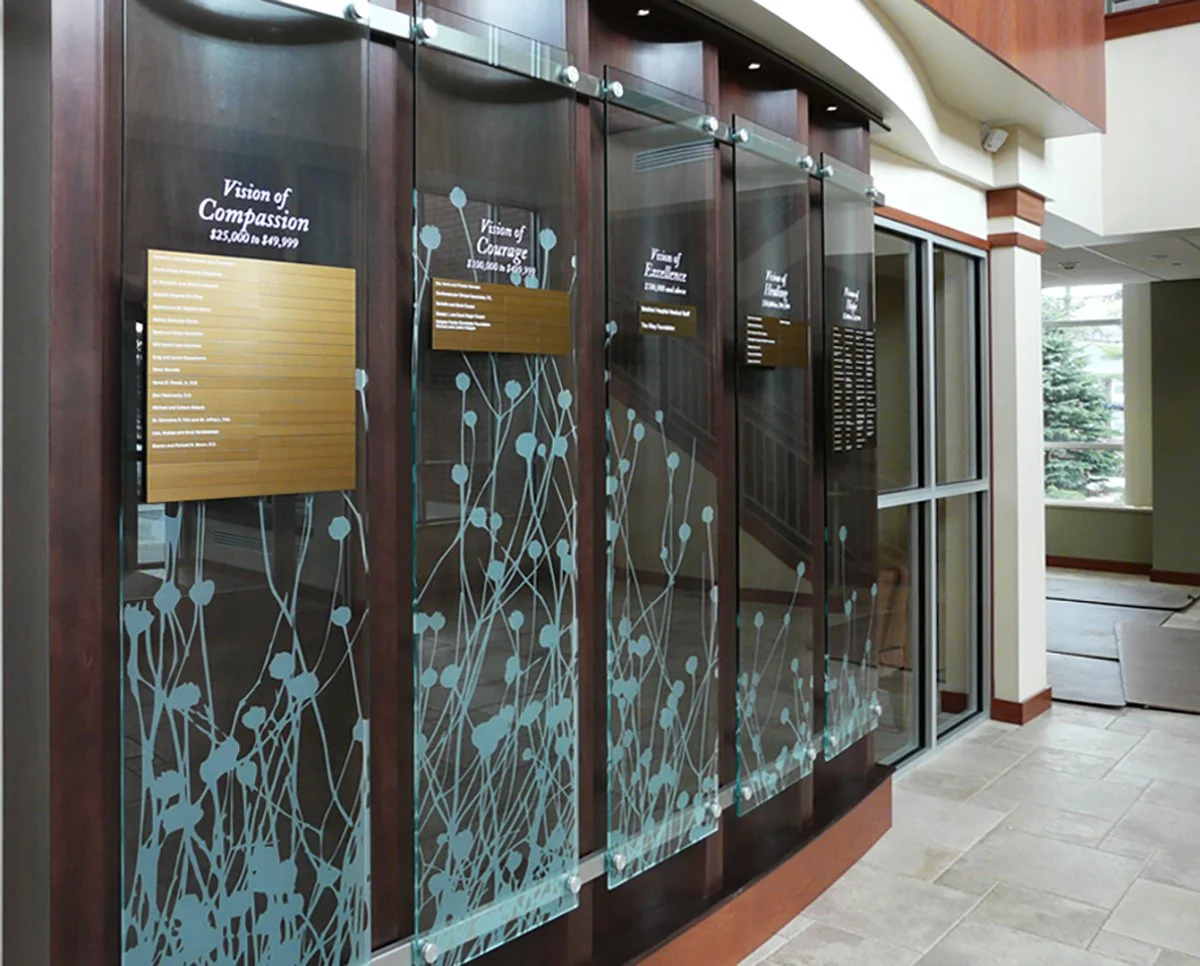
When your goal is to make a profound architectural statement, often in a main lobby or high-traffic atrium, a custom dimensional donor wall is required. Costs scale in this tier due to premium materials (such as architectural glass, brushed metals, and custom millwork), integrated lighting, and mission-focused storytelling graphics. These turnkey installations require rigorous engineering, precise site measurements, and specialized mounting hardware to ensure a seamless fit within your building’s environment.
Digital & Hybrid Donor Walls (~$20,000 – $100,000+)
Digital donor walls justify their higher upfront investment by offering unmatched flexibility, interactive storytelling, and a virtually unlimited donor capacity. The budget encompasses commercial-grade screens (touch or non-touch), custom software interfaces, searchable directories, and ongoing content management support.
Suggestion: We frequently recommend a Hybrid Donor Wall. This approach bridges the gap by combining a permanent, physical installation for your highest-tier major donors with an integrated digital screen that displays rotating annual donors, campaign impact videos, and easily updatable giving tiers.
Large Integrated Donor Recognition System (~$75,000 – $250,000+)
This tier moves beyond a single wall. Large systems are comprehensive, campus-wide programs that encompass a primary custom donor wall, secondary departmental displays, room-naming plaques, and integrated wayfinding signage. These complex deployments are typical of expanding hospital campuses, major universities, and cultural institutions that require strict brand consistency across multiple buildings and recognition zones.
The 5 Main Drivers of Donor Wall Pricing
When evaluating quotes, boards must look beyond raw material costs. A true turnkey design-build partner factors the entire project lifecycle into the estimate. Here are the five primary drivers of your final cost:
1. Strategy, Discovery, and Design
A successful wall begins with a clear strategy. Before fabrication begins, specialized design work must be done to define recognition goals, establish giving tiers, and ensure architectural alignment. Custom brand integration, 3D renderings, readability testing, and spatial planning ensure the final product looks like a natural extension of your facility, rather than an afterthought.
2. Fabrication and Material Selection
The physical components drastically shift the budget. Flat, printed acrylic or vinyl applications are highly economical. Conversely, utilizing back-painted glass, waterjet-cut dimensional metal lettering, custom hardwoods, and integrated LED halo lighting requires advanced fabrication techniques, higher material costs, and specialized finishing. Exterior installations also demand weather-resistant, UV-stable materials that carry a premium over interior lobby displays.
3. Size and Donor Capacity
Scale dictates cost. A display accommodating 50 legacy donors requires vastly different engineering than a capital campaign wall honoring 1,000 individual contributors. Larger walls require more raw materials, heavier structural backing, more intricate layout grids, and extensive installation labor.
4. Site Conditions and Installation Needs
Installation is rarely as simple as hanging a picture. Budget variances often stem from site-specific realities. Does the wall require structural reinforcement behind the drywall? Is an electrical conduit needed for digital screens or backlit lettering? Will the installation team require after-hours access to avoid disrupting hospital patients or university classes? Professional site surveys help lock in these costs early.
5. Future Updates and Donor List Management
One of the most frequently underestimated phases is donor list cleanup. Inconsistent name formatting, last-minute spelling corrections, and shifting giving tiers during the design proofing stage can lead to costly delays and rework. Additionally, how the wall accommodates future names dictates long-term costs. Investing slightly more upfront in a modular update system or digital software license will save thousands of dollars when it is time to refresh the list next year.
Cost Considerations by Organization Type
Different sectors face unique stewardship challenges that influence their recognition budgets and design choices.
Nonprofits and Community Foundations
For community-focused nonprofits, the priority is often balancing maximum impact with strict budgetary oversight. These organizations typically lean toward modular systems or hybrid walls that clearly define giving levels while allowing for cost-effective annual updates. The design must deeply reflect the community's mission to inspire future grassroots and mid-level giving.
Hospitals and Healthcare Facilities
Healthcare foundations operate in sensitive environments where the patient experience is paramount. Donor walls in these settings must be visually soothing, compliant with stringent accessibility and infection-control standards, and integrated with hospital wayfinding. Budgets here often skew higher due to the need for large-scale, multi-location plaque programs that span various wings, waiting rooms, and donor-funded surgical centers.
Universities and Educational Institutions
Higher education institutions manage incredibly complex, constantly evolving donor databases that encompass alumni, athletic boosters, and endowment contributors. Universities frequently invest in digital or highly scalable modular systems capable of managing thousands of names, as well as campus-wide naming-rights programs for lecture halls and laboratories.
Museums and Cultural Institutions
For fine art galleries and museums, the recognition signage must never compete with the exhibits. Budgets in this sector heavily prioritize high-end, minimalist architectural design and premium materials that blend seamlessly into the gallery space, creating a refined, understated acknowledgment of patrons and benefactors.
Hidden Costs to Avoid During Planning
Without an experienced guide, hidden fees can quickly derail a non-profit’s carefully planned budget. Protect your investment by planning for these commonly overlooked factors:
Incomplete Donor Data: As mentioned, it is critical to finalize your donor list before fabrication. Late additions or spelling corrections after plaques are engraved result in costly rush re-fabrication.
Electrical and Structural Prep: Do not assume your lobby wall is ready to hold 500 pounds of glass or plug in a commercial display. Budgeting for local contractors to run power or reinforce studs is necessary.
Software Subscriptions: If opting for a digital wall, ensure you understand the ongoing annual costs for the content management software, hosting, and technical support, not just the physical screen.
Shipping and Logistics: For large, custom architectural elements, specialized crating and freight shipping are required to ensure materials arrive undamaged.
How to Set a Realistic Donor Wall Budget
Setting a budget should be a strategic exercise, not a guessing game. Follow these steps to align your board’s expectations with reality:
Start With Your Recognition Goals
Define the primary purpose. Are you wrapping up a one-time capital campaign, or do you need a permanent installation that will absorb annual giving updates for the next decade? Knowing the why prevents overspending on features you don't need.
Define the Donor Tiers Early
Your donor data dictates the design. Audit your records immediately to determine the exact number of names, the threshold for your top naming opportunities, and the formatting rules (e.g., "Mr. and Mrs. John Smith" vs. "The Smith Family"). A clean, locked list streamlines the entire process.
Include the Full Turnkey Scope
Do not budget strictly for raw materials. Ensure your financial planning accounts for discovery strategy, custom design rounds, specialized fabrication, hardware, and professional, insured installation. Partnering with a comprehensive firm provides a single, reliable cost projection.
Set Aside a Contingency
Particularly for installations in older buildings or rapidly moving campaigns, setting aside a 10% to 15% contingency fund provides peace of mind. It ensures that if site conditions change or a major last-minute donor needs to be added, the project proceeds without having to return to the board for emergency approvals.
Is a Custom Donor Wall Worth the Investment?
When executed correctly, the return on investment for a donor recognition system extends far beyond the immediate aesthetics of your lobby.
A thoughtfully designed wall is a vital tool for donor stewardship. It publicly validates your supporters' generosity, showing them that their commitment is permanently valued. Furthermore, it serves as a silent, continuous fundraiser. When prospective donors, visiting families, or community leaders walk through your doors and see a beautifully organized display of community support, it builds institutional credibility. It visually demonstrates that others trust your organization with significant capital, inspiring them to join that legacy of giving.
A high-quality recognition system connects the tangible gift to the emotional mission, turning a blank wall into your most effective development asset.
Ready to Connect Generosity to Your Mission?
Transitioning from a rough budget estimate to a completed, awe-inspiring donor wall requires an expert guide. You shouldn't have to navigate complex architectural designs, material selections, and installation logistics alone while managing your organization's mission.
At DonorSigns, we utilize a proven 3-step process to eliminate the stress of recognition planning:
Discovery Call: We listen to your vision, understand your mission, and align your goals with a realistic budget.
Design with Purpose: Our team transforms your donor data and brand identity into thoughtful, architectural concepts.
Turnkey Implementation: From state-of-the-art fabrication to on-time, professional installation, we handle every detail.
Ready to move from a budget estimate to a custom concept? Book a Discovery Call with DonorSigns today. Our team will help you align your recognition goals with a design that fits your space, respects your budget, and beautifully honors your donors' lasting legacy.
Frequently Asked Questions
1. How can an organization estimate donor recognition wall cost before requesting a quote?
Start with the number of donor names, giving levels, wall location, update needs, and preferred recognition type. A small plaque display may require a lower budget. In contrast, a custom donor wall, digital donor wall, or campus-wide recognition system requires a larger planning budget because it includes design, fabrication, installation, and planning for future updates.
2. Why do donor recognition wall prices vary so much between projects?
Donor recognition wall pricing varies because each project has a different size, donor list, material choice, design complexity, installation conditions, and technology requirements. A simple wall of donors with engraved plaques costs much less than a custom dimensional wall or interactive donor wall with software, content, and digital display hardware.
3. Is it better to choose a physical or digital donor wall for long-term donor updates?
A physical donor wall works well when the donor list is stable, and recognition needs to feel permanent. A digital donor wall works better when the organization expects frequent updates, large donor lists, campaign stories, videos, or searchable donor names. Some organizations use a hybrid system to combine permanent recognition with flexible digital content.
4. What should nonprofits include in a donor wall budget besides materials?
A complete donor wall budget should include strategy, donor level planning, design, donor name formatting, proofing, fabrication, hardware, installation, maintenance, and future updates. If the project includes a digital recognition display, the budget should also include software, content management, support, and possible hardware replacement.
5. How can a donor recognition wall be designed to avoid expensive updates later?
Plan the wall with growth in mind. Use modular panels, replaceable plaques, flexible donor tiers, or digital content tools if the donor list is likely to change. Finalize donor names before fabrication, leave space for future giving levels, and choose a recognition system that can support new campaigns without requiring a full redesign.