
Detroit Riverfront Donor Recognition Program
Wayfinding & Recognition Challenges
The challenges of a high-profile, linear public project are uniquely complex.
Unlike most destinations with defined entrances, the Riverwalk has virtually unlimited access points.
Visitors who become disoriented can feel unsafe; confusion increases frustration and diminishes the overall experience.
Guests need to locate amenities—restrooms, plazas, food service, playgrounds—quickly and intuitively.
Visitors must also find their way back to their point of entry along a corridor with few naturally memorable landmarks.
Donor recognition needed to be visible and meaningful without overwhelming the environment or competing with wayfinding.
The strategy had to be clearly communicated and broadly supported by donors, city officials, community organizations, neighborhood residents, and faith groups.
Balancing clarity, security, and recognition within a continuous public landscape required a holistic design approach.
Integrated Wayfinding & Donor Recognition Solutions
Our strategy combined clear, repeatable wayfinding elements with layered donor recognition embedded throughout the Riverwalk experience.
Wayfinding System
Large directional signs were placed adjacent to each north–south street intersection along the Riverwalk. Each sign prominently features the street name at the top, reinforcing visitors’ awareness of where they entered and where they are along the route. For guests unfamiliar with street sequences, integrated “You Are Here” maps provide immediate orientation.
The body of each sign directs visitors to major destinations such as plazas, overlooks, and amenities, creating a consistent and reassuring navigation rhythm along the entire corridor.
Donor Recognition Integration
Donor recognition was designed to feel intentional, dignified, and inseparable from the place itself.
Sculptural Donor Wall:
A signature sculptural donor wall serves as a focal point, celebrating major contributors while acting as a memorable landmark along the Riverwalk. Its form and materials were selected to complement the surrounding architecture and landscape, making it both a recognition feature and a point of visual interest.Named Spaces & Gardens:
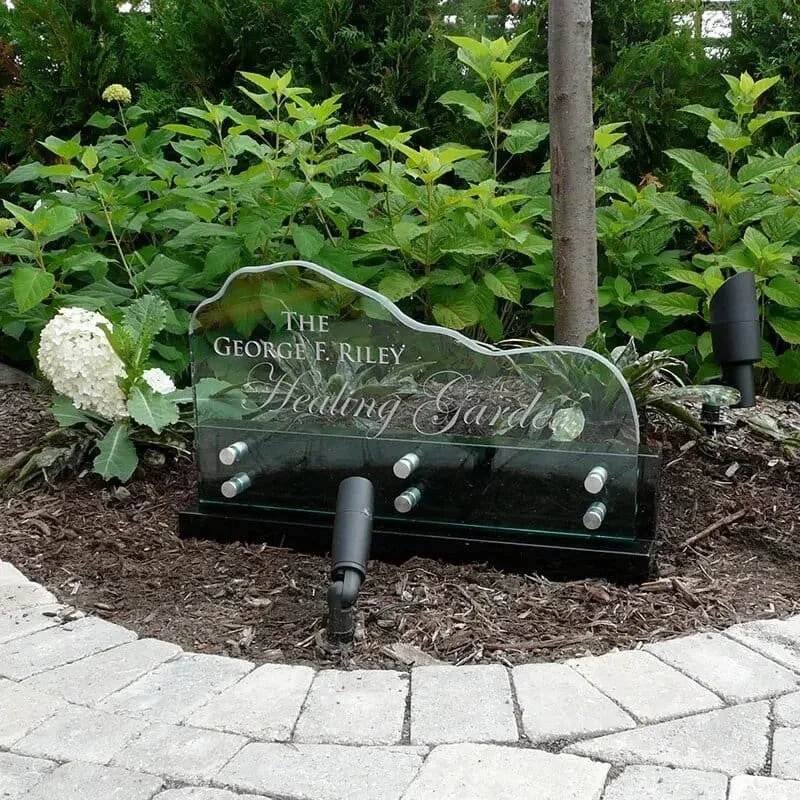
Key plazas, overlooks, and landscaped areas were named in recognition of significant donors. These named spaces function as natural wayfinding references while reinforcing donor legacy through everyday use and enjoyment.Plaques & Interpretive Elements:
Discreet plaques and donor acknowledgments were thoughtfully placed within gathering areas, gardens, and circulation zones—ensuring visibility without clutter or visual fatigue.
Together, these elements allow visitors to intuitively associate places with names, strengthening orientation while honoring philanthropic support.
Communication & Community Engagement
To ensure alignment across stakeholders, we developed a comprehensive presentation document that illustrated:
Overall wayfinding strategy
Individual sign designs and messaging
Donor recognition locations and typologies
Exact sign and recognition placement along the Riverwalk
The final document—measuring over 12 feet long—enabled donors, city officials, and community members to clearly understand how navigation and recognition worked together as a unified system.
Result
The Detroit Riverwalk’s wayfinding and donor recognition systems work in concert to create an experience that is welcoming, legible, and meaningful. Visitors feel confident navigating the space, while donors are recognized in a manner that enhances—rather than interrupts—the public realm.
The result is a waterfront that is not only easy to use, but rich with identity, memory, and shared civic pride.